

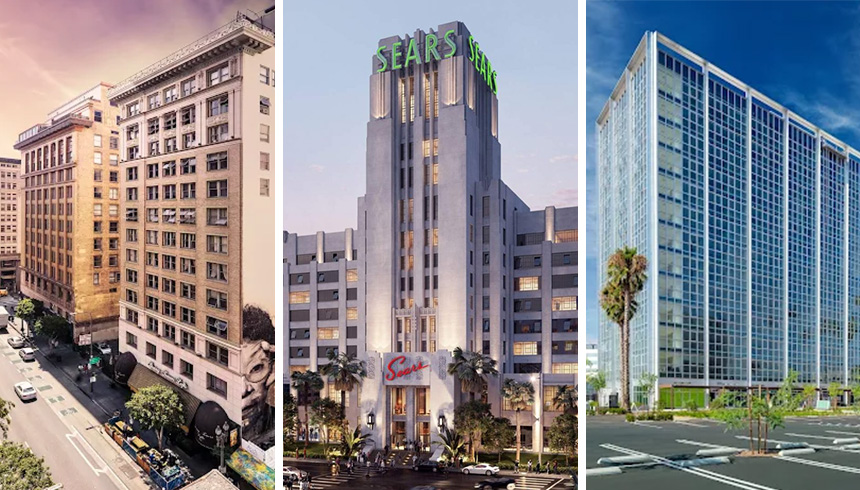
(East West Bank is helping Shomof Group repurpose underutilized commercial buildings into new residential housing and revitalize communities across Los Angeles. Photos of Spring Towers, Sears Building and Panorama Towers courtesy of Shomof Group.)
Across the United States, cities are confronting a paradox: office towers stand increasingly empty while housing shortages continue to deepen.
The situation is especially visible in Los Angeles, where more than 50 million square feet of office space sits vacant across the region.
For developers, those empty buildings are beginning to represent something else entirely—opportunity.
Increasingly, they are being transformed into residential communities through adaptive reuse, the conversion of underutilized commercial buildings into housing. The approach is emerging as one of the most practical ways for cities to add new homes while revitalizing aging downtown districts.
But turning office towers into housing is far from simple. These projects often require complex financing structures, years of planning and lenders willing to support unconventional redevelopment.
For decades, East West Bank has been one of those lenders.
The Pasadena-based bank has built specialized expertise financing adaptive reuse and affordable housing developments throughout California—helping developers bring new housing to market while revitalizing communities.
“COVID fundamentally changed the commercial real estate landscape. Office vacancies increased dramatically, and in some cases property values fell as much as 80% to 90%. Adaptive reuse allows developers to convert those buildings into housing and bring people back into downtown districts,” said Robert Lo, Executive Vice President & Head of Commercial Real Estate Banking, East West Bank.
Reviving Cities Through Adaptive Reuse
Few developers have done more to reshape downtown Los Angeles than Izek Shomof, a longtime pioneer of adaptive reuse redevelopment.
For more than two decades, Shomof has transformed aging office buildings into residential communities—often in neighborhoods once written off as relics of a fading past.
Along Spring Street in downtown Los Angeles, he led the redevelopment of several landmark properties including City Lofts, Spring Tower Lofts, Premier Tower Lofts, Milano Lofts and Panorama Tower.
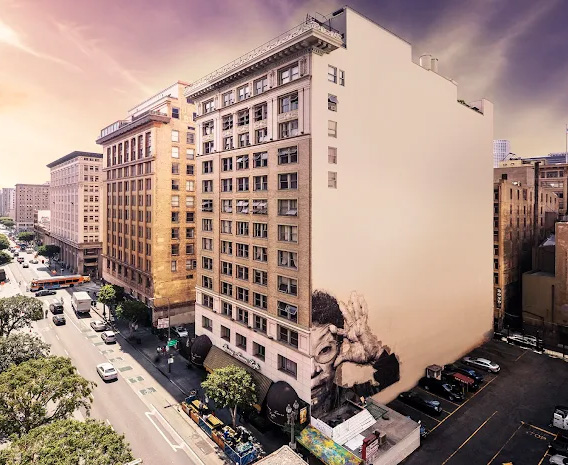
(Photo of Spring Towers courtesy of Shomof Group.)
The projects helped reintroduce residents to downtown neighborhoods and sparked the return of small businesses—cafés, restaurants and boutiques—that follow growing residential populations.
East West Bank has partnered with Shomof on many of these projects.
“We work with many banks, but the one I feel most comfortable with is East West Bank,” Shomof said. “They understand my business and financial needs. After working together for so many years, I can simply pick up the phone and reach my relationship manager. That responsiveness helps move projects forward.”
In adaptive reuse, speed and experience often determine whether redevelopment opportunities succeed.
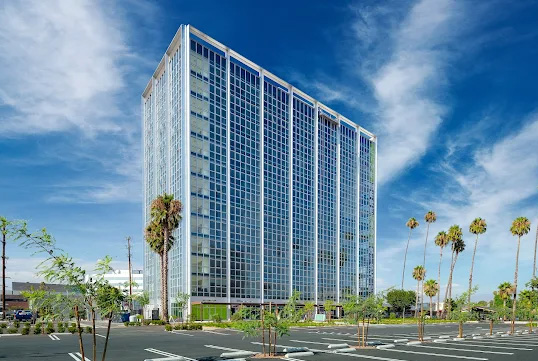
(Photo of Panorama Towers courtesy of Shomof Group.)
A New Wave of Conversions
The next generation of adaptive reuse projects may be even larger.
Shomof recently proposed converting a 24-story office tower in Long Beach into 391 residential units, repurposing nearly 480,000 square feet of office space.
He has also been acquiring aging office buildings at deep discounts as commercial real estate markets adjust to changing workplace patterns.
In Glendale, Shomof purchased 101 N. Brand Boulevard for $58.5 million, less than half its value from a decade earlier.
In downtown Los Angeles, he acquired 617 W. Seventh Street for $20.5 million, roughly half its previous valuation.
Last year, he also purchased Landmark Square in Long Beach for $50 million, a steep discount from the property’s $135.5 million purchase price in 2013.
East West Bank helped finance that acquisition with a $25 million loan in 2025.
Across these projects, the Bank has provided construction financing, acquisition loans and operational banking services.
“When I have a project that requires financing, I reach out to East West Bank,” Shomof said. “They understand what it takes to get these projects done.”
Policy Changes Begin to Unlock Housing
Adaptive reuse is gaining momentum partly because policymakers are beginning to remove regulatory barriers that historically slowed housing development.
Several recent reforms are accelerating progress.
- California has more than doubled production of new affordable homes in the past five years.
- San Diego’s housing reforms helped drive a 10% increase in new housing construction.
- Los Angeles recently made permanent its Affordable Housing Streamlining Ordinance, reducing approval timelines from as long as nine months to about 60 days.
Even with those changes, development in California remains complex.
Higher interest rates have increased financing costs. Tariffs have raised prices for construction materials and equipment. Environmental review processes can extend project timelines.
Development impact fees in California for multifamily and single-family housing are also three times the national average.
Yet the combination of vacant office space and growing housing demand continues to make adaptive reuse an increasingly attractive solution.
Data Snapshot
California’s Housing Affordability Gap
- California homes are roughly twice as expensive as the typical mid-tier U.S. home.
- Only 45% of California households could likely qualify for a mortgage on a bottom-tier home based on their 2025 income—down from 60% in 2019.
- Renters must earn 2.8 times the state minimum wage to afford the average asking rent.
- Median rent has increased 40% since 2000, while renter incomes have risen only 9%.
- 79% of extremely low-income renters spend more than half their income on housing.
Sources:
California Legislative Analyst’s Office
California Housing Partnership
Financing the Future of Urban Housing
Adaptive reuse projects typically require a carefully structured capital stack that can include construction loans, tax credits, grants and other incentives.
That complexity is where specialized lenders play an important role.
East West Bank has spent decades building expertise in helping developers assemble these financing structures while navigating the challenges that arise throughout redevelopment.
“Our value proposition is our experience as an established lender in adaptive reuse,” Lo said.
“These projects are complicated. Developers want a bank that understands the process and can structure the right financing solution.”
When redevelopment projects succeed, the benefits extend far beyond a single building.
Vacant commercial properties become homes. New residents support neighborhood businesses. Downtown districts regain economic vitality.
“The story looks great when the building is finished,” Lo said. “But getting there takes the right partners.”
Commercial Real Estate
East West Bank is delivering tailored construction and acquisition financing and deposit and operational banking solutions to expand housing opportunities and help neighborhoods reach further.
Related Articles
-

Affordable Housing Transforms Family Futures and Golden Years
East West Bank serves our communities and helps bridge the gap in affordable housing, including for senior citizens, low-income individuals and families, and service workers.
-
A Dialogue with SGV Habitat on Rebuilding After Wildfires
Robert Lo of East West Bank interviews Bryan Wong of SGV Habitat about rebuilding after the Eaton and Palisades wildfires and how the community can support long-term recovery.

Subscribe to the Reach Further Newsletter
Get inspiring stories in your inbox every month.
Thank you for subscribing to the Reach Further Newsletter.
Form submission issue
Please try to submit the form again.
You're leaving our website
East West Bank’s privacy and security policies do not apply to the website or app you’re about to visit, and we are not responsible for the products, services or content found there. Please review its terms of use, privacy and security policies to see how they apply to you.