


(Photo courtesy of Navigator Schools.)
Launching a charter school begins with a core belief: that education can be delivered differently. Turning that belief into a functioning institution, however, increasingly depends on access to capital.
Across the United States, charter schools have expanded as educators experiment with curriculum design, governance and delivery models. Yet as the sector grows, its financing constraints have become more pronounced. Operators must navigate uneven state funding, limited access to facilities and a patchwork of regulatory requirements—often without the balance sheets or credit histories traditional lenders require.
“Charter schools operate in a hybrid space,” said Caprice Young, CEO of Navigator Schools. “They serve a public mission but don’t always have access to public infrastructure, which makes financing more complex.”
Capital Constraints and Uneven Access
Facilities remain one of the sector’s most persistent challenges. Unlike traditional public schools, charter operators often lack access to district-owned buildings and must secure, finance or retrofit their own sites.
In lower-income communities, the gap is more acute. Bakersfield, California’s ninth-largest city, illustrates the challenge. Only 23 percent of high school graduates attend college, well below the state average of 35 percent, according to state education data.1
In 2024, local educators and parents launched the Central Academy of Arts and Technology (Caat), Bakersfield’s first tuition-free TK–12 school designed to integrate arts and technology into its curriculum. Like many new schools, it faced immediate funding pressures—from facilities upgrades to staffing.

(Photo courtesy of Caat.)
A line of credit from East West Bank enabled the school to refinance existing obligations, modernize classroom space and expand teaching capacity. Within a year, enrollment more than doubled and reading proficiency improved by 40 percent, according to the school.
“When you talk to most banks, it’s a transaction,” said Greg West, CEO of Caat. “What we needed was a partner who understood how charter schools actually operate.”
The Rise of Relationship-Based Lending
Traditional banks have often approached charter schools as standard commercial borrowers, focusing on collateral and short-term credit metrics. Sector participants argue that this model does not fully capture how schools function, where funding is tied to enrollment, state reimbursements and academic performance.
In response, the East West Bank lending team has developed more tailored approaches, combining credit products with advisory support.
Having established a dedicated charter school banking division, East West Bank is expanding in the space. Its model emphasizes relationship management and sector familiarity.
“Schools are not just looking for capital—they need a partner who understands the operational side, as well,” said John Helgeson, Senior Vice President, Charter School and Non-Profit Division at East West Bank.
Nonprofits also play a role in bridging financing gaps. Building Hope, for example, focuses on facilities financing and development for charter schools.
“Our focus is on aligning capital with long-term outcomes for students,” said Dru D’Amico, President of Real Estate at Building Hope. “That means structuring financing so schools can grow without being burdened by unsustainable debt.”
Scaling Models—and Risks
For established charter networks, access to financing can accelerate expansion.
Navigator Schools has grown from roughly 2,000 students to more than 6,000 in recent years, supported in part by East West’s flexible financing. Additional funding is being used to develop new campuses and expand facilities. Navigator reports that more than 700 alumni have progressed to higher education, reflecting the sector’s broader ambitions.
But rapid expansion also introduces risk. Charter schools face scrutiny over academic outcomes, governance and financial sustainability. Lenders, in turn, must balance growth opportunities with credit discipline.
“Scaling requires discipline,” said Young. “Access to capital is essential, but so is making sure growth is sustainable.”
Bridging Networks and Policy
Beyond financing, access to networks and policy insight is becoming an important differentiator.
In April, East West Bank convened policymakers, educators and finance professionals at the 2026 Ohio Charter School Leadership Summit. Participants included U.S. Senator Bernie Moreno, along with state education officials and sector leaders.
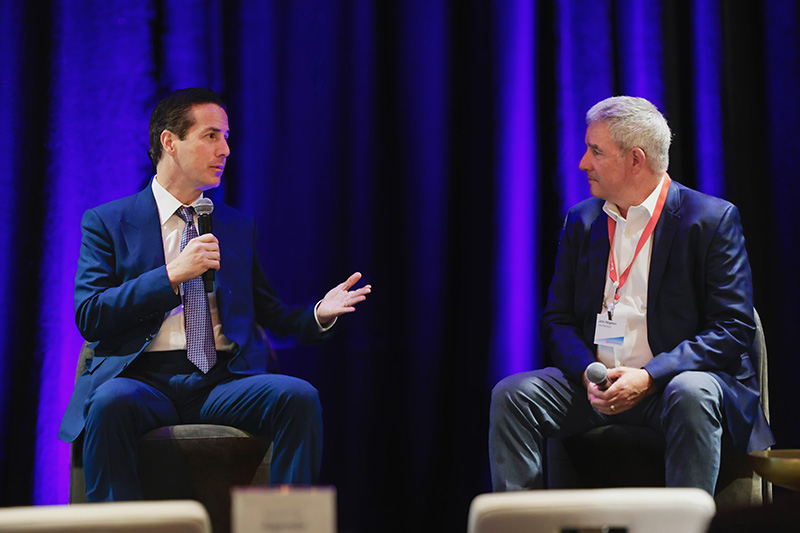
U.S. Senator Bernie Moreno (left) joined East West Bank SVP John Helgeson at EWB’s Ohio
Charter School Leadership Summit to discuss the issues shaping charter school growth.
(Photo by East West Bank.)
“Many charter school leaders don’t have access to the networks that help institutions grow,” said Rob Giordano, First Vice President, Charter School and Non-Profit Division at East West Bank. “Connecting those dots is an important part of the ecosystem.”
A Maturing Market
As the charter school sector matures, its financing needs are becoming more complex. Early-stage schools require flexible capital to launch, while established networks seek structured financing to scale.
For lenders, this creates both opportunity and risk. Success depends not only on deploying capital, but on understanding a sector where financial performance is closely tied to educational outcomes.
“Capital alone is not enough,” said Helgeson. “You need to understand how these schools operate to support them effectively.”
Institutions that combine financing with sector expertise are likely to play a growing role as charter schools continue to expand—and as the demands on them evolve.
Charter School Banking
East West Bank is supporting charter school growth through flexible financing and strategic partnership.

Subscribe to the Reach Further Newsletter
Get inspiring stories in your inbox every month.
Thank you for subscribing to the Reach Further Newsletter.
Form submission issue
Please try to submit the form again.
You're leaving our website
East West Bank’s privacy and security policies do not apply to the website or app you’re about to visit, and we are not responsible for the products, services or content found there. Please review its terms of use, privacy and security policies to see how they apply to you.