

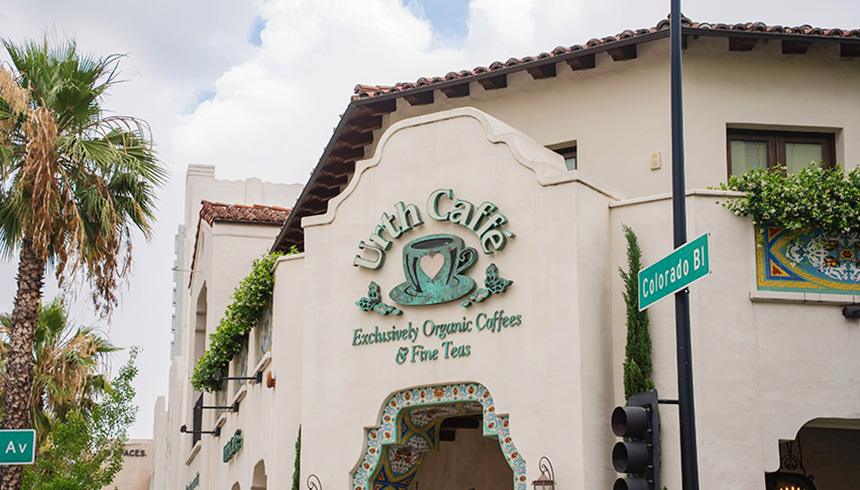
Urth Caffé Pasadena location. Photo East West Bank.
What happens after a visionary transforms a passion into a purpose and that purpose into a global brand?
For Urth Caffé founders Shallom and Jilla Berkman, the answer has never been rapid expansion or short-term optimization. Instead, the couple has spent more than three decades building deliberately—guided by conviction, shaped by experimentation and sustained by community.
More than 30 years after opening their first café, the Berkmans continue to run Urth Caffé with a simple belief: Hospitality can be both commercially successful and socially intentional.
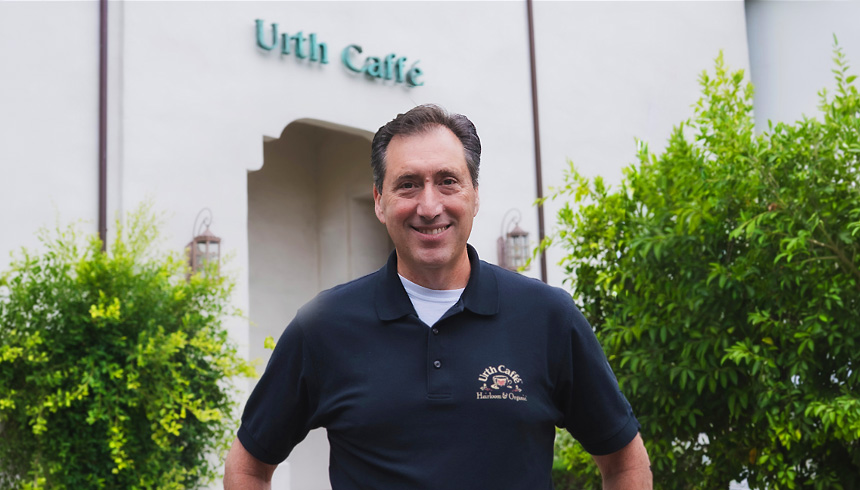
Shallom Berkman at the Urth Caffé Pasadena location.
Photo East West Bank.
A Different Starting Point
The idea behind Urth Caffé began with a shared entrepreneurial spirit.
“My wife Jilla and I are entrepreneurs at heart,” Shallom Berkman said. “Her dream was to open a coffee house. For me, it was about how we could do something environmentally responsible and health conscious.”
That question sharpened in 1989 at a natural foods convention, where the couple met a Peruvian farmer cultivating one of the world’s first certified organic heirloom coffee farms.
The encounter reframed their ambition. Coffee, they learned, is one of the world’s most chemically treated agricultural commodities. Heirloom organic coffee offered a healthier and more environmentally sustainable alternative.
“That was the spark,” Berkman said. “We realized we could build a coffee company that was better for people and better for the environment.”
Two years later, Urth Caffé launched as what Berkman describes as the first exclusively heirloom organic coffee roaster in the United States.

Photo courtesy of Urth Caffé.
Growth Without a Straight Line
The concept resonated culturally before it succeeded financially.
Urth Caffé did not turn a profit during its first decade. Early iterations were intentionally narrow: a coffee-focused concept with limited offerings and no seating. Over time, customer behavior pushed the company to evolve.
“There was a lot of experimentation to understand what people actually wanted,” Berkman said. “It became clear they wanted more than coffee. They wanted food, space and somewhere to spend time.”
That shift from coffee outlet to full café experience proved foundational. Expanded menus, larger footprints and an emphasis on ambience repositioned Urth Caffé closer to European café culture, where cafés function as gathering places rather than transactional stops.
Expansion was gradual and financed primarily through private investors. Each location was structured individually, often anchored by property ownership after an early setback involving eviction from a leased site in Manhattan Beach.
“That experience taught us that if we wanted to build something lasting, we needed control of the real estate,” Berkman said.
“We never set out to build something short term. The goal has always been to create places that last and become part of people’s lives.”
— Shallom Berkman
The Role of Partnership
By the late 2000s, Urth Caffé had established a loyal following but remained capital constrained.
A turning point came with the Pasadena location, a redevelopment project requiring both property acquisition and construction financing. The deal marked the beginning of Urth Caffé’s relationship with East West Bank.
“It was a complex project,” Berkman said. “We didn’t have a long banking history, and it required both vision and trust to move forward.”
The project succeeded and reshaped the company’s growth trajectory.
Since then, East West Bank has supported multiple expansions, including financing for projects across California and Las Vegas, as well as operational banking services tailored to Urth Caffé’s retail business.
More significant than the financing itself, Berkman said, has been the advisory relationship.
One pivotal moment came when Urth Caffé considered consolidating its properties under a single ownership structure ahead of the pandemic.
“We reversed that decision within 24 hours,” Berkman said. “Our East West relationship manager had advised us that any disruption could put all our assets at risk. When COVID hit, that choice likely saved the company.”
“Our East West relationship manager had advised us that any disruption could put all our assets at risk. When COVID hit, that choice likely saved the company.”
— Shallom Berkman
Scaling the Concept
Today, Urth Caffé operates nine company-owned locations and more than two dozen licensed international sites. Expansion increasingly follows a partnership model, with local operators leading development in new markets while maintaining the brand’s identity and standards.
Upcoming projects include new locations in Texas and London.
Yet Berkman remains cautious about defining success purely by footprint.
A Business Rooted in Community
Despite its growth, Urth Caffé’s philosophy remains rooted in hospitality as a form of service.
Berkman still visits his cafés daily, tasting products, observing customers and refining the experience firsthand.
“You’re always thinking about how to make it better,” he said. “But what keeps you going is knowing you’re creating something meaningful for the community.”
That long-term, relationship-driven mindset is one reason Urth Caffé found alignment with East West Bank. Both organizations have built their growth around serving communities and helping people expand beyond their starting points.
For East West Bank, that mission has long centered on building bridges between cultures, markets and entrepreneurs—helping clients “Reach Further” through long-term partnership rather than transactional banking.
“When people come to Urth, we want them to feel part of something,” Berkman said. “We want their lives to be better for having been here: healthier, happier, more connected.”
In an industry often defined by speed and turnover, Urth Caffé has taken a different approach: investing in relationships, building trust over time and creating an institution designed to endure.

Subscribe to the Reach Further Newsletter
Get inspiring stories in your inbox every month.
Thank you for subscribing to the Reach Further Newsletter.
Form submission issue
Please try to submit the form again.
You're leaving our website
East West Bank’s privacy and security policies do not apply to the website or app you’re about to visit, and we are not responsible for the products, services or content found there. Please review its terms of use, privacy and security policies to see how they apply to you.