

Ai Weiwei (Chinese, b. 1957) is one of the most significant Chinese artists in contemporary art and globally recognized as political activist. His provocative work has solidified him as one of the leading cultural figures of his generation and serves as an example for free expression internationally.
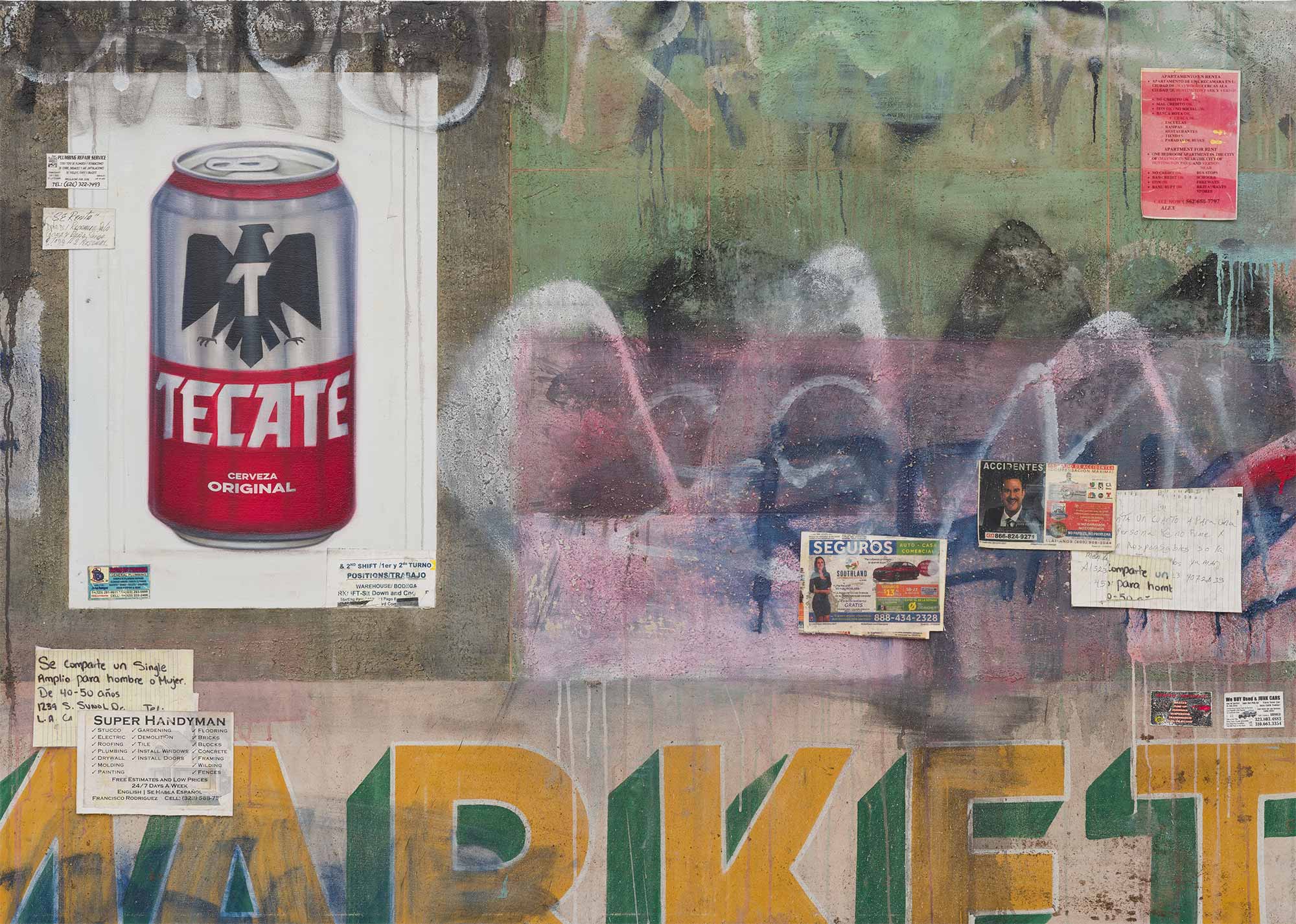
Alfonso Gonzalez Jr. is a contemporary painter whose Mexican heritage and experiences growing up in East Los Angeles have infused his artwork with rich symbolism and imagery, drawing upon elements of mythology, spirituality, and traditional craftsmanship.
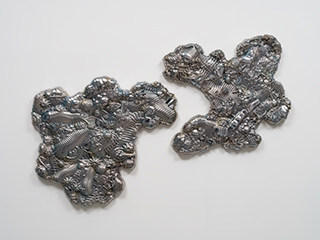
Anicka Yi (Korean, b. 1971) is a conceptual artist known for her use of unconventional materials to create multi-sensory experiences. Engaging senses such as smell and taste, Yi’s work reimagines the boundaries of fine art, inviting views to physically and viscerally encounter her explorations of identity, biology and systems of knowledge.
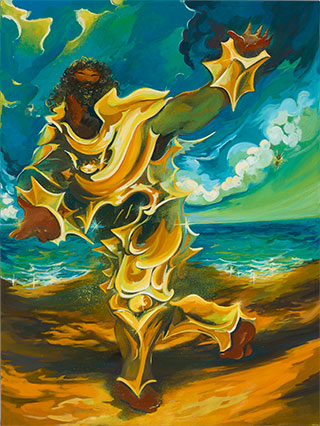
Asif Hoque (American, b. 1991) evokes myth and legend in his expressive, narrative paintings. His multi-cultural background lends complex symbolic meaning to his images, with gold playing a central role in his work, symbolizing both light and memory.

Cai Guo-Qiang is among the most important Chinese artists working in global contemporary art. He has gained international recognition for his explosive artworks, which involve igniting gunpowder on paper, canvas or glass to create intricate patterns and dynamic compositions.

Chase Hall (American, b. 1993) uses brewed coffee and white cotton canvas to produce scenes of modern americana. Hall’s auto-biographical and expressive paintings and portraits challenge a monolithic vision of Black life while embracing a vibrant, expansive humanity.

Chris Huen Sin Kan is a contemporary Chinese artist known for his sensitive figural paintings using a technique inspired by Chinese ink painting that explore the minute experiences of everyday life.

Christine Tien Wang (American, b. 1985) is a contemporary painter whose work is at once comforting and ironic. Recreating internet memes in oil paint, Wang critiques the greed of the increasingly digital world.

Cui Jie (Chinese, b. 1983) is a contemporary artist based in Shanghai, China. Her paintings depict architectural sites that examine the ongoing social and economic changes of modern cities.

Devin B. Johnson (American, b. 1992) is a California-native and New York-based contemporary artist. His practice engages with found and captured materials to produce imagined intimate scenes inspired by personal experiences.

Dominique Fung is a contemporary Canadian painter known for her captivating paintings that blend elements of realism and fantasy while drawing on her Chinese heritage and contemporary pop culture.

Greg Ito is an artist who meticulously renders bright, flat colors to juxtapose symbols of the state’s natural bounty and opportunity with the ever-present threat of natural disasters.

Guan Xiao (Chinese, b. 1983) is a contemporary artist whose practice spans sculpture, painting, installation, and video, developing a distinctive visual language through a collage-based approach.

Guimi You (Korean, b. 1985) brings her training in traditional Korean painting, as well as her time spent living in California, to her artwork, blurring reality and daydreams to create paintings alive with magical realism. Her hazy and colorful presentation of everyday scenes transforms them into enchanting dreamscapes.

Han Bing (Chinese, b. 1986) is a China-born and Paris-based contemporary artist engaged with capturing scenes of urban landscapes by elevating the mundane to the realm of fine art.

Hu Xiaoyuan (Chinese, b. 1977) is an artist based in Beijing whose works use fragile, everyday materials to explore the passage of time, the persistence of memory, and the essential facts of human existence. Her work creates contemplative spaces that examine the relationship between the physical world and personal experience.

Jammie Holmes (American, b. 1984) is a Dallas-based contemporary artist. His paintings reflect his youth in Louisiana and examine the complex legacy of poverty and racism in the state.

Julia Jo (b.1991, South Korea) is a New York-based painter whose vibrant oil paintings move between representation and abstraction. Her paintings are grounded in the self-doubt, conflict, and misunderstanding that can arise in any relationship. Through expressive depictions of human figures and familiar objects, she uses line, color, and shadow to reveal certain details while leaving others obscured.

Kelly Akashi (American, b. 1983) is a contemporary artist known for conceptual installations and sculptures that incorporate craft techniques such as glass-blowing, casting, candle-making and stone carving.
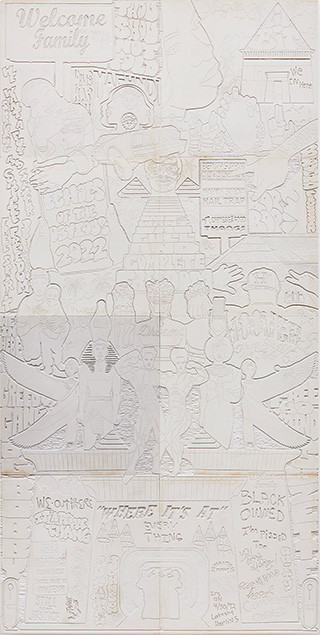
Lauren Halsey is a contemporary artist who has quickly gained international recognition for her standalone artworks and site-specific installations that draw from Afrofuturism and Funk art as well as the South Central neighborhood of Los Angeles where her family has lived for several generations.

Lee Bul (Korean, b. 1964) is a pioneering contemporary artist whose sculptures and installations examine the intersections of technology, architecture, the body, and utopian ambition. Internationally acclaimed for her visionary practice, she is widely regarded as one of South Korea's most significant living artists.

Leslie Martinez (American, b. 1985) is an artist whose abstract paintings deconstructs binary concepts through non-traditional structures and vibrant colors.
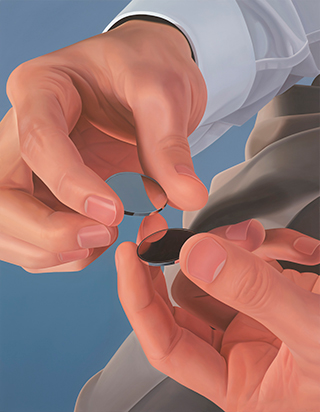
Liang Hao (Chinese, b. 1988) is an ultra-contemporary artist whose paintings use fragmental images of the human form, together with reflective metal forms to ask the viewer to interrogate their relationship to the world around them, and themselves.

Lin Guocheng (Chinese, b. 1979) is a contemporary Chinese artist whose work integrates classical Eastern shapes and landscapes with Western architecture and surrealist elements. Working in pen and ink, his intricate work has a dimensionality wherein the main subjects seem to overflow from the defined space of the page.

Liu Wei (Chinese, b. 1972) is a Beijing-based multidisciplinary artist whose paintings, sculptures, and installations explore the social and physical realities of urban life in contemporary China, including its rapid construction, excess, and disorder.

Liu Xiaodong (Chinese, b. 1963) is a contemporary painter best known for large-scale figurative works that document the social and economic transformations of modern life. Through direct observation and a deeply humanistic approach, Liu has become one of the most influential painters working in China today.

Lotus L. Kang (Canadian, b. 1985) is a contemporary artist whose photography, sculpture, and installation works explore material transformation, memory, and impermanence. Known for her use of light-sensitive photographic materials, she creates immersive environments that blur the boundaries between photography, sculpture, and space.

Lucy Bull (American, b. 1990) is a New York-born contemporary painter based in Los Angeles who is primarily known for intensely colorful abstract paintings that hover between surrealist landscapes and psychedelic dreams.

Lui Shou-kwan (Chinese, 1919-1975) was a significant pioneer of the New Ink Movement in China and a key figure in the creation of the artistic identity of Hong Kong. Adapting traditional Chinese ink painting to the here-and-now, Lui is best known for his abstract Zen paintings.

Maggi Hambling (British, b.1945) is one of Britain’s most distinguished artists, painting those close to her as they live and die, as well as making striking landscapes of her Suffolk seaside home. She is also well known for her public sculpture works. In her 60-year career, Hambling works are collected by major museums in the UK, the USA, Australia and globally.

Martin Wong (Chinese American, 1946-1999) was a Chinese-American painter best known for his richly detailed depictions of New York City's Lower East Side. Blending social realism with Chinese visual traditions, text, and symbolism, his paintings explore themes of identity, belonging, memory, and cultural exchange across subjects that span the city’s urban landscape and his deeply personal evocations of Chinatown.

M aka Michael Chow was born in 1939 into a family of theater in Shanghai, China. At the age of 13, he was uprooted to London, England; he lost everything familiar, even his name. To fulfill his void and loss of identity, he appointed himself as a cultural ambassador. He founded his first restaurant, MR CHOW, in Knightsbridge, London, and after a fifty-year radical sabbatical, M re-ignited his passion for painting, emerging with a 2015 solo show. Passionately promoting the greatness of China, M orchestrates art, architecture, design and cuisine into a participatory theater.

Michael Lin (Taiwanese, b. 1964) is a multi-disciplined artist best known for transforming the institutional architecture of the public museum. His monumental paintings invite visitors to reconsider their usual perception of those spaces, and to become an integral part of the work.

Patrick Martinez (American, b. 1980) is an LA-based contemporary artist whose multimedia artworks incorporate neon and other found objects to engage with how social and geographic factors impact personal identity.

Rick Lowe (American, b. 1961) is a Houston-based artist most-recognized for his diverse artistic practice that includes community-based activations that engage with social and political affairs in the hopes of driving change.

Sadie Barnette is a contemporary multimedia artist based in Oakland whose practice explores her own family history as it mirrors a collective history of repression and resistance in the United States.
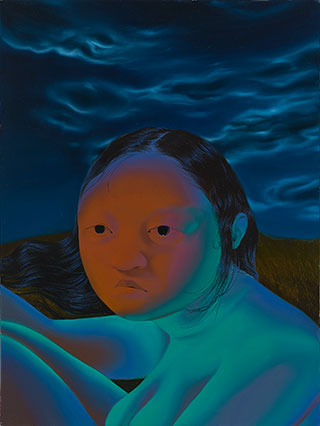
Sasha Gordon (American, b. 1998) is known for deeply personal figurative paintings that address themes of self-image, exoticization, mental illness, and the male gaze.

Su Xiaobai (Chinese, b. 1949) is an abstract artist who has spent decades transforming lacquer, an ancient medium of Chinese craft, into a vehicle for meditative, luminous abstraction that bridges Eastern tradition and postwar Western modernism.

Tidawhitney Lek is a contemporary painter whose large-scale figurative canvases merge colorful everyday scenes from both her American upbringing and her family's Cambodian roots.

Tyrus Wong, celebrated as one of the most prominent Chinese-American artists of the 20th century, gained fame for his visionary illustration work on Disney movies, including 1942's "Bambi", and his continued dedication to blending traditional Chinese art to atypical media and in Western commercial settings.

Vivien Zhang (Chinese, b. 1990) is a London based artist whose work asks us to question the flawed linguistic, visual and taxonomic systems that we use to understand all facets of life. Using vibrant colors and visceral, physical shapes, her work draws the viewer into her questioning, mysterious world.

Wang Jianwei (Chinese, b. 1958) is a contemporary artist, known for his concept-driven, cross-disciplinary practice. Drawing from philosophy, mathematics, and scientific experimentation, his work explores how knowledge systems shape perception and experience. Through paintings and multi-media works, he constructs complex, time-based narratives that challenge conventional forms.

Wang Tiande (Chinese, b. 1960) trained in classical Chinese painting and calligraphy and now reimagines these classical techniques to create multifaceted works which invite reflection on the synthesis of past and present, creation and destruction.

Wu Chi-Tsung (Taiwanese, b. 1981) is a multidisciplinary artist whose work reimagines the traditions of Chinese landscape painting through photography, installation, and contemporary media. Widely exhibited internationally and selected to represent Taiwan at the 57th Venice Biennale, Wu has emerged as one of the most important contemporary Taiwanese artists working today.

Xu Bing is one of the leading conceptual artists working today, known for mixed-media installations that simultaneously evoke and subvert centuries-old Chinese cultural traditions, such as calligraphy, wood-block printing, and landscape painting scrolls.

Xu Zhen is one of China’s leading conceptual artists known for a diverse artistic practice including photography, installations, and video art that often employs theatrical humor and social critique to challenge societal norms.

Yang Fudong (Chinese, b. 1971) is an internationally acclaimed artist and filmmaker known for cinematic video installations that explore memory, identity, and the complexities of contemporary Chinese society. His visually immersive works have established him as one of the leading figures in contemporary moving-image art. His work has been shown at MoMA, the Guggenheim, Tate Modern, and the Venice Biennale.

Yoko Ono (Japanese, b. 1933) is a pioneering conceptual and performance artist whose work has transformed understandings of art and its relationship to everyday life. Since the early 1960s, her instructions, performances, films, music, and participatory works have invited others to imagine, act, and become part of the work itself.

Yu Hong is prominent Chinese contemporary artist who is best known for her deeply personal paintings that explore themes of memory, femininity, and shifting roles for women in Chinese society.

Yuri Yuan (Chinese, b. 1996) is a contemporary painter currently living and working in New York. Interested in narrative and emotional storytelling, her surrealistic scenes present landscapes of haunting beauty and deeply-felt loneliness.

Zeng Fanzhi (Chinese, b. 1964) is a celebrated painter of expressive portraiture and sweeping, gestural landscapes which attempt to redefine the abstract. Inspired by different Western art schools as well as classical Chinese art forms, his works try to create an original approach to a universal vocabulary.

Zhan Wang (Chinese, b. 1962) is best known for his Artificial Rocks (Jia Shan Shi) series, which combines the traditional forms of the Chinese Scholar’s Rocks with contemporary mediums finishes, creating art that both speaks to history and looks towards the future.

Zhang Enli is a contemporary Chinese artist born in 1965 in Jilin Province who is best known for his introspective paintings that often depict everyday objects and interior spaces, exploring themes of transience, memory, and the passage of time.

Zhang Huan (Chinese, b. 1965) is one of the world-renowned contemporary artists. His performance art that challenges the physical limits has made the world re-examine contemporary Chinese art. His pioneering "incense ash art" system has become the most prominent part of his artistic practice.

Zhang Xiaogang (Chinese, b. 1958) is best known for his celebrated Bloodline paintings, which explore memory, identity, and the legacy of modern Chinese history. A defining figure of contemporary Chinese art, his work has achieved global institutional and market recognition.

Zheng Chongbin is a prominent Chinese-American contemporary artist who has skillfully integrated the ancient art of Chinese ink painting with Western abstract techniques throughout his four-decade long career.

Zhu Jinshi is a renowned Chinese contemporary artist known as a pioneer of both Chinese abstract painting and installation art, creating innovative artworks that evoke a sense of tranquility and contemplation.
You're leaving our website
East West Bank’s privacy and security policies do not apply to the website or app you’re about to visit, and we are not responsible for the products, services or content found there. Please review its terms of use, privacy and security policies to see how they apply to you.